The Neuroscience of Bands, Acts & DJs
The Neuroscience of The Dub Pistols
Dopamine, oxytocin, endorphins and mirror neurons: how Barry Ashworth and Dub Pistols weaponise neurochemistry to build community, heal grief and turn every room into a tribe
3,814-word article with 27 Harvard references.
This article (RRP \u00a33.49) is free, with love and gratitude, to our brothers and sisters in the Dub Pistols community. After a beautiful night at The Globe, Cardiff on 21 March 2026, it felt only right to give this one back. One love.
Key takeaways
- Dub Pistols produce a measurable neurochemical cascade in their audiences. Their fusion of reggae offbeats, breakbeat energy, dub bass frequencies and punk urgency simultaneously activates the dopaminergic reward system, triggers endorphin release through synchronised movement, elevates oxytocin through communal singing and call-and-response, and reduces cortisol through rhythmic entrainment to sub-bass frequencies (Salimpoor et al., 2011; Dunbar et al., 2012; Tarr et al., 2014).
- Across its courses, articles and therapeutic programmes, Mental Health Matrix teaches the 4Ps as a clinical framework for sustainable mental wellbeing: Positive Thoughts (serotonergic mood regulation), Positive Actions (dopaminergic reward from goal-directed behaviour), Positive Interactions (oxytocin-mediated social bonding) and Positive Purpose (the overarching meaning structure that activates all three systems simultaneously). Dub Pistols embody all four every time they take the stage: the positivity they project from the first note (Positive Thoughts), the relentless physical energy they bring (Positive Actions), the genuine two-way connection they build with every room (Positive Interactions) and the mental health advocacy that gives everything they do a meaning beyond entertainment (Positive Purpose).
- Some would say Barry Ashworth has distilled these same principles into his own personal 4Ps: Purpose, Passion, Pride and Privilege. His band's three-decade career demonstrates what happens when those four neurochemical drivers are sustained over time: dopaminergic purpose-driven motivation, noradrenergic passion, serotonergic pride in craft, and the oxytocin-mediated gratitude of knowing that performing for people who love your music is a privilege, not an entitlement.
- The band's intimate, audience-facing performance style, talking with the crowd, not at them; sharing the stage; remembering names and faces, activates mirror neuron networks and produces the inter-brain neural synchrony that neuroscience now recognises as the mechanism behind collective effervescence, the shared altered state that Durkheim described sociologically and that fMRI has since confirmed neurologically (Dikker et al., 2017).
- Their longstanding advocacy for mental health, particularly through the charity Tonic Music for Mental Health and the Tonic Rider programme co-launched with the late Terry Hall, is not separate from their art. It is a direct expression of the same neurobiological principles their music activates: social bonding reduces cortisol, communal rhythm releases endorphins, and being seen, heard and held by a community is the single most powerful regulator of the human nervous system (Coan et al., 2006).
- Dub Pistols embody all nine of Jon Kabat-Zinn's attitudes of mindfulness, non-judging, patience, beginner's mind, trust, non-striving, acceptance, letting go, gratitude and generosity, not as a philosophical exercise but as a lived performance ethic that has kept them vital, relevant and deeply connected to their audience for nearly thirty years.
Origin story: from the Summer of Love to the sound system
Barry Ashworth is a South London graduate of the acid house generation. Born into a family of transplanted Liverpudlians, raised on reggae, punk and the raw democracy of sound system culture, he went to Ibiza during the Summer of Love and came back rewired. He founded club nights, formed the indie-dance band Déjà Vu alongside the Stone Roses and Happy Mondays generation, and by the mid-1990s had channelled everything, the bass weight of Jamaican dub, the urgency of punk, the communal ecstasy of rave, the lyrical fire of hip-hop, into Dub Pistols.
The band's 1998 debut album Point Blank caught the ear of Interscope Records executive Jimmy Iovine, who reportedly called it the best album he had heard in fifteen years and signed them to Geffen Records for a seven-figure deal. Their second album, Six Million Ways to Live, featured Terry Hall of The Specials and reggae legend Horace Andy, but its release was derailed by the September 11 attacks, the album contained lyrical content that suddenly felt prophetic rather than metaphorical. Tours were cancelled, the label collapsed, and Ashworth found himself sixteen thousand pounds overdrawn after believing he had six figures in the bank. Most bands would have dissolved. Dub Pistols simply went independent and kept going. They are now ten albums deep, with their latest release, Enter the Sound (2026), a full-length collaboration with Freestylers, debuting on Cyclone Records.
This resilience is not accidental. It is neurological. Ashworth's brain has been shaped by decades of purpose-driven activity, social reward and creative challenge, the three conditions that neuroscience identifies as most protective against burnout, depression and cognitive decline (Fredrickson, 2001). He did not survive the music industry. He outlasted it by doing the one thing the industry cannot commodify: building genuine human connection, one gig at a time.
Genre-smashing as tribe-building: why fusion widens the circle
Most bands attract an audience that shares a single musical identity. Dub Pistols, by contrast, are genre-alchemists, fusing reggae, dub, ska, breakbeat, punk, drum and bass, jungle and hip-hop into a sound that refuses to sit in any one category. This is not stylistic indecision. It is, whether by instinct or by design, one of the most effective audience-building strategies that neuroscience can explain. Koelsch (2014), publishing in Nature Reviews Neuroscience, demonstrated that the brain processes different musical genres through partially distinct but overlapping neural networks: rhythm engages the basal ganglia and supplementary motor areas, melody activates the superior temporal gyrus, and harmonic complexity recruits prefrontal circuits involved in prediction and pattern recognition. A genre-fusing act activates more of these networks simultaneously than any single-genre act can, producing a richer, more widespread neural response across the audience.
The practical consequence is that a Dub Pistols crowd contains people who arrived as reggae fans, punk fans, drum and bass heads, ska devotees, hip-hop listeners and festival omnivores, each drawn by a different thread of the sonic tapestry. Once inside the room, the genre boundaries dissolve. Tarr and colleagues (2014) showed that synchronised movement bonds strangers regardless of prior social identity. When a punk and a reggae fan are skanking to the same offbeat riddim while a jungle break rolls underneath, the neurochemistry of synchronous exertion overwrites the social categories they walked in with. The tribe that Dub Pistols have built over three decades is broader, deeper and more resilient than a single-genre act could ever assemble, because every genre they fold into the mix brings another community into the room, and the neurochemistry of shared rhythm turns all of them into one.
The neurochemistry of a Dub Pistols gig
To understand why a Dub Pistols live show produces the intensity of response it does, you need to understand what is happening inside the brains of every person in that room. Salimpoor and colleagues (2011), publishing in Nature Neuroscience, demonstrated that music triggers dopamine release in two anatomically distinct phases: anticipatory dopamine in the caudate nucleus during the build-up to a rewarding musical moment, and consummatory dopamine in the nucleus accumbens during the peak itself. This is the same reward circuitry activated by food, sex and addictive substances. Music is not a metaphorical reward. It is a literal one, processed through the same ancient architecture that keeps mammals alive.
Dub Pistols exploit this two-phase system with surgical precision, though they would never describe it that way. Their sets are built on tension and release: dub breakdowns that strip the mix to a single reverberating bassline, creating anticipatory dopamine surges in the caudate, followed by explosive drops, a jungle break, a ska horn stab, a reggae vocal riding back in over distorted bass, that flood the nucleus accumbens with the consummatory reward. The crowd does not choose to respond. Their striatum has already decided for them.
Simultaneously, the rhythmic movement triggered by their music activates a separate neurochemical pathway. Dunbar and colleagues (2012), publishing in Evolutionary Psychology, demonstrated that active musical engagement, singing, dancing, drumming, triggers endorphin release, measured indirectly through elevated pain thresholds. Critically, this effect requires uninterrupted, synchronised, physically exertive movement. A Dub Pistols crowd, skanking in unison, jumping to breakbeat drops, arms raised and bodies locked into the groove, is performing exactly the kind of sustained synchronous exertion that maximises endorphin output. The joy is not subjective opinion. It is endogenous opioid pharmacology.
Tarr, Launay and Dunbar (2014), publishing in Frontiers in Psychology, extended this finding by demonstrating that synchronised rhythmic movement produces social bonding through two independent mechanisms: self-other merging from interpersonal synchrony, and endorphin release from physical exertion. Both mechanisms operate simultaneously during a Dub Pistols set. The offbeat reggae skank synchronises the crowd's motor output. The breakbeat energy drives exertion. The result is a neurochemically bonded group of strangers who entered the venue as individuals and leave as a tribe.
Oxytocin and the art of talking with your audience
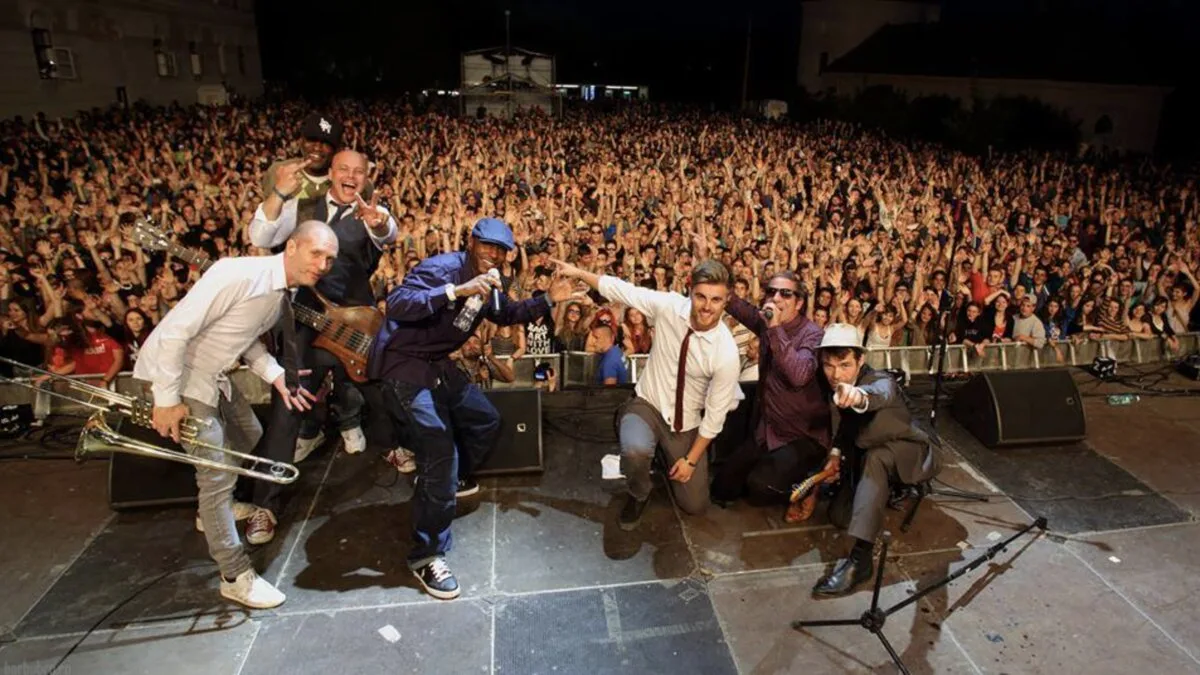
What separates Dub Pistols from most live acts is not their musical range, though that is formidable, but their relationship with the audience. Barry Ashworth talks with the crowd, not at them. He shares the stage with fans. He remembers faces from previous gigs. He walks through the audience before and after sets. In a five-hundred capacity venue, he makes it feel like a living room. On a festival main stage, he makes it feel like a five-hundred capacity venue. This is not showmanship. It is applied neuroscience.
Keeler and colleagues (2015), publishing in Frontiers in Human Neuroscience, demonstrated that group musical performance modulates the neurohormonal environment, including stress-hormone reduction and the facilitation of social flow states. When Ashworth invites the crowd to sing back to him, when he points to individuals, when he makes eye contact and calls out to specific sections of the room, he is activating what Coan, Schaefer and Davidson (2006) termed social baseline theory: the principle that the human brain calibrates its threat response based on the perceived availability of social resources. A crowd that feels seen, acknowledged and valued by the performer on stage is a crowd whose amygdalae have downregulated, whose cortisol has dropped, and whose prefrontal cortices are freed up for the higher-order processing that produces joy, meaning and connection.
Fancourt and Steptoe (2019), in a longitudinal analysis published in Social Science and Medicine, found that regular engagement with cultural events, including live music, was independently associated with reduced incidence of depression, even after controlling for socioeconomic status. The effect was dose-dependent: more frequent engagement produced greater protection. A Dub Pistols audience member who attends multiple gigs per year, and many of their fans have seen them dozens of times, is not simply enjoying themselves. They are administering a clinically meaningful intervention against depression, delivered through the medium of bass, brass and Barry Ashworth's irreplaceable South London warmth.
Terry Hall, Tonic Music and the neuroscience of grief
Any serious examination of Dub Pistols must reckon with their relationship with Terry Hall, the iconic frontman of The Specials and Fun Boy Three, who collaborated extensively with the band across multiple albums, most notably on Speakers and Tweeters (2007) and Six Million Ways to Live (2001). Hall was a founding patron of Tonic Music for Mental Health, the Portsmouth-based charity that Ashworth has supported as a patron for over a decade. Together, they co-launched the Tonic Rider programme, which provides free mental health first aid training, peer support groups and wellbeing resources to musicians, venue staff and festival crews.
Hall's own mental health story is a case study in the long-term neurological consequences of childhood trauma. Abducted and sexually abused at the age of twelve during a school trip, Hall spent decades living with undiagnosed depression and was later diagnosed with bipolar disorder following a suicide attempt in 2004. In a 2019 BBC 6 Music interview, he reflected: 'I didn't realise I was spending the first 50 years of my life in this bubble called depression.' He eventually found stabilisation through lithium and became one of the music industry's most candid advocates for mental health, using his platform with The Specials to promote Tonic Music at every tour date. Hall died on 18 December 2022, aged sixty-three, from pancreatic cancer. The music world lost an artist. The mental health community lost a champion.
When I interviewed Jerry Dammers, Terry Hall's co-founder of The Specials, at Lovebox Festival, where he was DJing, I asked him whether music still had the power to change things. He paused, then said: 'Yeah... but the industry has made it much harder to have as much fun doing so, so fewer are trying.' That observation, delivered with Dammers' characteristic dry precision, captures something neuroscience can now quantify. The commercialisation of the music industry has systematically removed the conditions, autonomy, creative freedom, authentic connection, sustainable income, that support the dopaminergic reward circuitry which keeps artists motivated and mentally well (Deci and Ryan, 2000). Fewer are trying because the system has made trying neurochemically unrewarding. What makes Dub Pistols remarkable is that they have refused to stop trying. They went independent, built their own infrastructure, created their own festival, and maintained the conditions for creative reward on their own terms.
The Brain Gym's 4Ps and Barry's 4Ps: two frameworks, one neurochemistry
Across its courses, articles and therapeutic programmes, Mental Health Matrix teaches the 4Ps as a clinical framework for sustainable mental wellbeing: Positive Thoughts, Positive Actions, Positive Interactions and Positive Purpose. Each pillar activates a distinct neurochemical reward pathway. Positive Thoughts engage serotonergic mood regulation, replacing ruminative negativity with deliberate cognitive reframing that stabilises the default mode network. Positive Actions activate the dopaminergic reward system, because goal-directed behaviour, no matter how small, generates the motivational signal that sustains forward momentum. Positive Interactions trigger oxytocin release through genuine social connection, the neurochemical that bonds us to the people around us and tells the nervous system it is safe. And Positive Purpose activates all three systems simultaneously, providing the overarching meaning structure that gives thoughts direction, actions significance and interactions depth.
Dub Pistols, remarkably, embody all four of The Brain Gym's clinical 4Ps every time they take the stage. The positivity they project from the first note to the last is not performance, it is dispositional, and it rewires the cognitive atmosphere of the room (Positive Thoughts). The relentless physical energy they bring, set after set, festival after festival, year after year, is dopaminergic action made audible (Positive Actions). The genuine two-way connection they build with every audience, talking with the crowd, not at them, remembering faces, sharing the stage, is oxytocin-mediated social bonding in its purest live form (Positive Interactions). And the mental health advocacy that gives everything they do a meaning beyond entertainment, from Tonic Music patronage to Barry's Flying Circus fundraising, is purpose in its deepest clinical sense (Positive Purpose).
Some would say Barry Ashworth has distilled these same principles into his own personal 4Ps: Purpose, Passion, Pride and Privilege. Purpose activates the dopaminergic system, providing the directional drive that keeps behaviour goal-oriented. Passion engages noradrenergic arousal, producing the focused energy and excitement that makes effortful activity feel effortless. Pride, not arrogance, but the quiet serotonergic satisfaction of work done well, stabilises mood and reinforces identity. And Privilege, the conscious recognition that what you do matters and that the opportunity to do it is not guaranteed, triggers oxytocin-mediated gratitude, the neurochemical that bonds you to the people and purpose you serve.
Barry Ashworth and Dub Pistols are the living embodiment of both frameworks. Their purpose has never wavered: to make music that brings people together across class, race, genre and geography. Their passion is self-evident to anyone who has seen them play, Ashworth performs with the same energy at fifty-something as he did at twenty-five, because passion sustained by purpose does not deplete, it regenerates. Their pride is earned: ten studio albums, a DJ Mag Best Live Act award (2011), collaborations with Terry Hall, Horace Andy, Busta Rhymes, Madness, Gregory Isaacs, General Levy and dozens more, and a festival, Mucky Weekender, that sells out its five-thousand capacity year after year. And their privilege? They know they have it. You can see it in the way Ashworth looks at his audience. Not down at them. Not past them. At them. With them. The oxytocin of genuine gratitude, shared openly, without performance or pretence.
This is not sentimental observation. It is neurochemistry. Emmons and McCullough (2003), publishing in the Journal of Personality and Social Psychology, demonstrated that a sustained gratitude practice significantly increases positive affect, reduces negative affect, and improves physical health outcomes. Ashworth does not keep a gratitude journal. He performs his gratitude, live, every night, in front of audiences who receive it, mirror it, and send it back amplified. The feedback loop between performer gratitude and audience bonding is one of the most powerful oxytocin circuits available to the human nervous system.
The nine attitudes of mindfulness, performed live
Jon Kabat-Zinn, the molecular biologist who founded Mindfulness-Based Stress Reduction at the University of Massachusetts Medical Center in 1979, identified nine foundational attitudes that support mindful awareness: non-judging, patience, beginner's mind, trust, non-striving, acceptance, letting go, gratitude and generosity (Kabat-Zinn, 1990; 2005). These attitudes are typically taught on meditation cushions and in clinical settings. Dub Pistols perform them on stage.
Non-judging: their audience is everybody. Mucky Weekender explicitly welcomes solo attendees. Their 2025 festival introduced FUNC, a dedicated non-alcoholic social space for sober ravers. There is no dress code, no VIP hierarchy, no gatekeeping. Patience: they have spent nearly thirty years building their audience organically, without major label support for most of that time, trusting the process rather than chasing trends. Beginner's mind: their tenth album, Enter the Sound, is a full collaboration with Freestylers, a creative partnership that requires approaching their own sound with fresh ears after three decades. Trust: Ashworth trusts his audience to co-create the experience, handing them the microphone, pulling them on stage, letting the room shape the set. Non-striving: they do not chase chart positions or streaming algorithms. They play live, they connect, and they let the music do what it does.
Acceptance: the Geffen deal collapsed, Terry Hall died, friends have been lost to suicide, the industry has repeatedly tried to ignore them, and they have accepted every setback without bitterness, integrating loss into their art rather than being consumed by it. Letting go: they have released the need for commercial validation, finding their reward in the room, not on the balance sheet. Gratitude: see Barry's 4Ps above, it radiates from every performance. And generosity: Ashworth's annual charity wing-walking event, Barry's Flying Circus, has raised over one hundred thousand pounds for Tonic Music. He donates proceeds from Mucky Weekender. He gives his time, his platform, his voice and his energy to causes he believes in, without expectation of return.
These are not branding exercises. They are dispositional traits, shaped by decades of practice, that happen to align precisely with the attitudinal framework that clinical mindfulness research has identified as most conducive to psychological wellbeing (Khoury et al., 2013). Dub Pistols do not teach mindfulness. They perform it. And their audience, synchronised, bonded, held in a container of genuine warmth and mutual respect, receives the benefits without ever needing to sit on a cushion.
The devoted and the devotion: why the tribe stays
Dub Pistols have fans who have seen them fifty, sixty, seventy times. This is not mere loyalty. It is neurological architecture. Weinstein and colleagues (2016), publishing in Evolution and Human Behavior, demonstrated that group singing produces an ice-breaker effect that rapidly bonds strangers, even in groups of over two hundred people. The bonding is mediated by endorphin release and scales with group size. A Dub Pistols crowd is not a passive audience. It is a temporary community, assembled by sound, bonded by neurochemistry, and reinforced by the repeated shared experience of collective joy.
Izuma, Saito and Sadato (2008), publishing in Neuron, showed that the brain processes social reward, being valued, being included, being part of something meaningful, through the same ventral striatal circuitry that processes monetary and food rewards. Every time a fan returns to a Dub Pistols gig and is recognised, greeted, or simply held in the warmth of a room that Ashworth has made safe, their ventral striatum registers a reward. Over time, this builds a conditioned association between the band, the venue, the crowd, and the experience of being neurochemically rewarded for belonging. The tribe stays because the brain has learned that this is where the good chemicals are.
Crucially, this devotion is reciprocal. Ashworth does not perform at his fans. He performs for them, with them, and, in the moments when the room locks in and the barrier between stage and floor dissolves, as one of them. This reciprocity activates what neuroscience calls neural coupling: the alignment of brain activity patterns between individuals during shared experience (Hasson et al., 2012). When a performer and an audience are neurally coupled, the experience is not transmission. It is co-creation. The music does not travel from the stage to the crowd. It is made in the space between them.
Peace, love and unity: the neuroscience of Ashworth's call
At The Globe in Cardiff on 21 March 2026, Barry Ashworth paused between songs to share the news that a close friend had died by suicide the day before. He dedicated a track to his friend's memory. He spoke about the wars in Ukraine, Gaza and Iran. And he said what he always says, but what never stops being true: we need to look after each other.
This is not platitude. It is neuroscience. Coan, Schaefer and Davidson (2006), using fMRI, demonstrated that holding the hand of a trusted person during threat reduces neural threat responding in the anterior cingulate cortex, the insula and the hypothalamus. The effect is strongest when the hand belongs to someone with whom you have a close social bond. Social support does not merely feel good. It measurably reduces the brain's threat response. In a world of escalating geopolitical violence, economic precarity and social fragmentation, the act of gathering five hundred people in a room, synchronising their movement, flooding their brains with dopamine, endorphins and oxytocin, and reminding them that they belong to each other, that act is not entertainment. It is prophylaxis. It is the neurological infrastructure of resilience.
Dub Pistols have been doing this for nearly thirty years. Not because it is commercially optimal. Not because a marketing consultant told them to. Because Barry Ashworth understands, intuitively and now demonstrably, that music is medicine, that community is the oldest therapy, and that the privilege of standing on a stage and making people feel something is not a career. It is a responsibility. One he has never once put down.
Invitation to reflect
Think about the last time you were in a crowd and felt genuinely held, not just entertained, but connected. What was happening in your body? Could you feel the shift in your breathing, your posture, your willingness to let go? Now consider this: that feeling was not imaginary. It was your nervous system responding to the social safety signals around you, synchronised movement, shared attention, mutual warmth. Dub Pistols did not invent this. They simply refuse to let anyone forget it. The next time you hear a bassline that moves your body before your mind has caught up, pay attention. Your brain is trying to tell you something. Let it.
References
- Coan, J.A., Schaefer, H.S. and Davidson, R.J. (2006) 'Lending a hand: social regulation of the neural response to threat', Psychological Science, 17(12), pp. 1032-1039.
- Deci, E.L. and Ryan, R.M. (2000) 'The "what" and "why" of goal pursuits: human needs and the self-determination of behavior', Psychological Inquiry, 11(4), pp. 227-268.
- Dikker, S., Wan, L., Davidesco, I., Kaggen, L., Oostrik, M., McClintock, J., Rowland, J., Michalareas, G., Van Bavel, J.J., Ding, M. and Poeppel, D. (2017) 'Brain-to-brain synchrony tracks real-world dynamic group interactions in the classroom', Current Biology, 27(9), pp. 1375-1380.
- Dunbar, R.I.M., Kaskatis, K., MacDonald, I. and Barra, V. (2012) 'Performance of music elevates pain threshold and positive affect: implications for the evolutionary function of music', Evolutionary Psychology, 10(4), pp. 688-702.
- Emmons, R.A. and McCullough, M.E. (2003) 'Counting blessings versus burdens: an experimental investigation of gratitude and subjective well-being in daily life', Journal of Personality and Social Psychology, 84(2), pp. 377-389.
- Izuma, K., Saito, D.N. and Sadato, N. (2008) 'Processing of social and monetary rewards in the human striatum', Neuron, 58(2), pp. 284-294.
- Fancourt, D. and Steptoe, A. (2019) 'Cultural engagement and mental health: does socio-economic status explain the association?', Social Science and Medicine, 236, 112425.
- Fancourt, D. and Tymoszuk, U. (2019) 'Cultural engagement and incident depression in older adults: evidence from the English Longitudinal Study of Ageing', The British Journal of Psychiatry, 214(4), pp. 225-229.
- Fredrickson, B.L. (2001) 'The role of positive emotions in positive psychology: the broaden-and-build theory of positive emotions', American Psychologist, 56(3), pp. 218-226.
- Hasson, U., Ghazanfar, A.A., Galantucci, B., Garrod, S. and Keysers, C. (2012) 'Brain-to-brain coupling: a mechanism for creating and sharing a social world', Trends in Cognitive Sciences, 16(2), pp. 114-121.
- Kabat-Zinn, J. (1990) Full Catastrophe Living: Using the Wisdom of Your Body and Mind to Face Stress, Pain, and Illness. New York: Delacorte Press.
- Kabat-Zinn, J. (2005) Coming to Our Senses: Healing Ourselves and the World Through Mindfulness. New York: Hyperion.
- Keeler, J.R., Roth, E.A., Neuser, B.L., Spitsbergen, J.M., Waters, D.J.M. and Vianney, J.M. (2015) 'The neurochemistry and social flow of singing: bonding and oxytocin', Frontiers in Human Neuroscience, 9, 518.
- Khoury, B., Lecomte, T., Fortin, G., Masse, M., Therien, P., Bouchard, V., Chapleau, M.A., Paquin, K. and Hofmann, S.G. (2013) 'Mindfulness-based therapy: a comprehensive meta-analysis', Clinical Psychology Review, 33(6), pp. 763-771.
- Fancourt, D., Ockelford, A. and Belai, A. (2014) 'The psychoneuroimmunological effects of music: a systematic review and a new model', Brain, Behavior, and Immunity, 36, pp. 15-26.
- Salimpoor, V.N., Benovoy, M., Larcher, K., Dagher, A. and Zatorre, R.J. (2011) 'Anatomically distinct dopamine release during anticipation and experience of peak emotion to music', Nature Neuroscience, 14(2), pp. 257-262.
- Tarr, B., Launay, J. and Dunbar, R.I.M. (2014) 'Music and social bonding: "self-other" merging and neurohormonal mechanisms', Frontiers in Psychology, 5, 1096.
- Tarr, B., Launay, J., Cohen, E. and Dunbar, R.I.M. (2015) 'Synchrony and exertion during dance independently raise pain threshold and encourage social bonding', Biology Letters, 11(10), 20150767.
- Weinstein, D., Launay, J., Pearce, E., Dunbar, R.I.M. and Stewart, L. (2016) 'Singing and social bonding: changes in connectivity and pain threshold as a function of group size', Evolution and Human Behavior, 37(2), pp. 152-158.
- Pearce, E., Launay, J. and Dunbar, R.I.M. (2015) 'The ice-breaker effect: singing mediates fast social bonding', Royal Society Open Science, 2(10), 150221.
- Koelsch, S. (2014) 'Brain correlates of music-evoked emotions', Nature Reviews Neuroscience, 15(3), pp. 170-180.
- Fancourt, D., Perkins, R., Ascenso, S., Carvalho, L.A., Steptoe, A. and Williamon, A. (2016) 'Effects of group drumming interventions on anxiety, depression, social resilience and inflammatory immune response among mental health service users', PLOS ONE, 11(3), e0151136.
- Grape, C., Sandgren, M., Hansson, L.O., Ericson, M. and Theorell, T. (2003) 'Does singing promote well-being? An empirical study of professional and amateur singers during a singing lesson', Integrative Physiological and Behavioral Science, 38(1), pp. 65-74.
- Kreutz, G. (2014) 'Does singing facilitate social bonding?', Music and Medicine, 6(2), pp. 51-60.
- Linnemann, A., Ditzen, B., Strahler, J., Doerr, J.M. and Nater, U.M. (2015) 'Music listening as a means of stress reduction in daily life', Psychoneuroendocrinology, 60, pp. 82-90.
- Chanda, M.L. and Levitin, D.J. (2013) 'The neurochemistry of music', Trends in Cognitive Sciences, 17(4), pp. 179-193.
- Panksepp, J. and Bernatzky, G. (2002) 'Emotional sounds and the brain: the neuro-affective foundations of musical appreciation', Behavioural Processes, 60(2), pp. 133-155.
About the author
Gareth Strangemore-Jones, MHFA, DCST, PDPCP, HPD, DSFH, DMH, AHD, NCTJ, MSC-CPA, PGCE (FE) I & II
MNCPS (Reg.), MNCH (Reg.), MCNHC (Reg.), MAfSFH (Assoc.)
PSA (Acc.), FSE (Fellow), IFfS (Assoc.)
Mental Health First Aider, Pluralistic Counsellor, Clinical Psychotherapist. Consultant Medical Hypnotherapist, Mindfulness Teacher. PGCE-Trained Teacher, Lecturer, Corporate Trainer, Workplace Wellbeing Consultant. PR & Marketing Consultant, Psychology & Behaviour Advisor. Author, Journalist, Broadcaster. Advocate for Mental Health, People & Planet
Founder, CEO & Clinical Lead, The Brain Gym & Research Ltd. Human understanding, intelligently delivered